
About and FAQ
What is CHOW GA TǑng LǑng?
什麼是周家螳螂拳
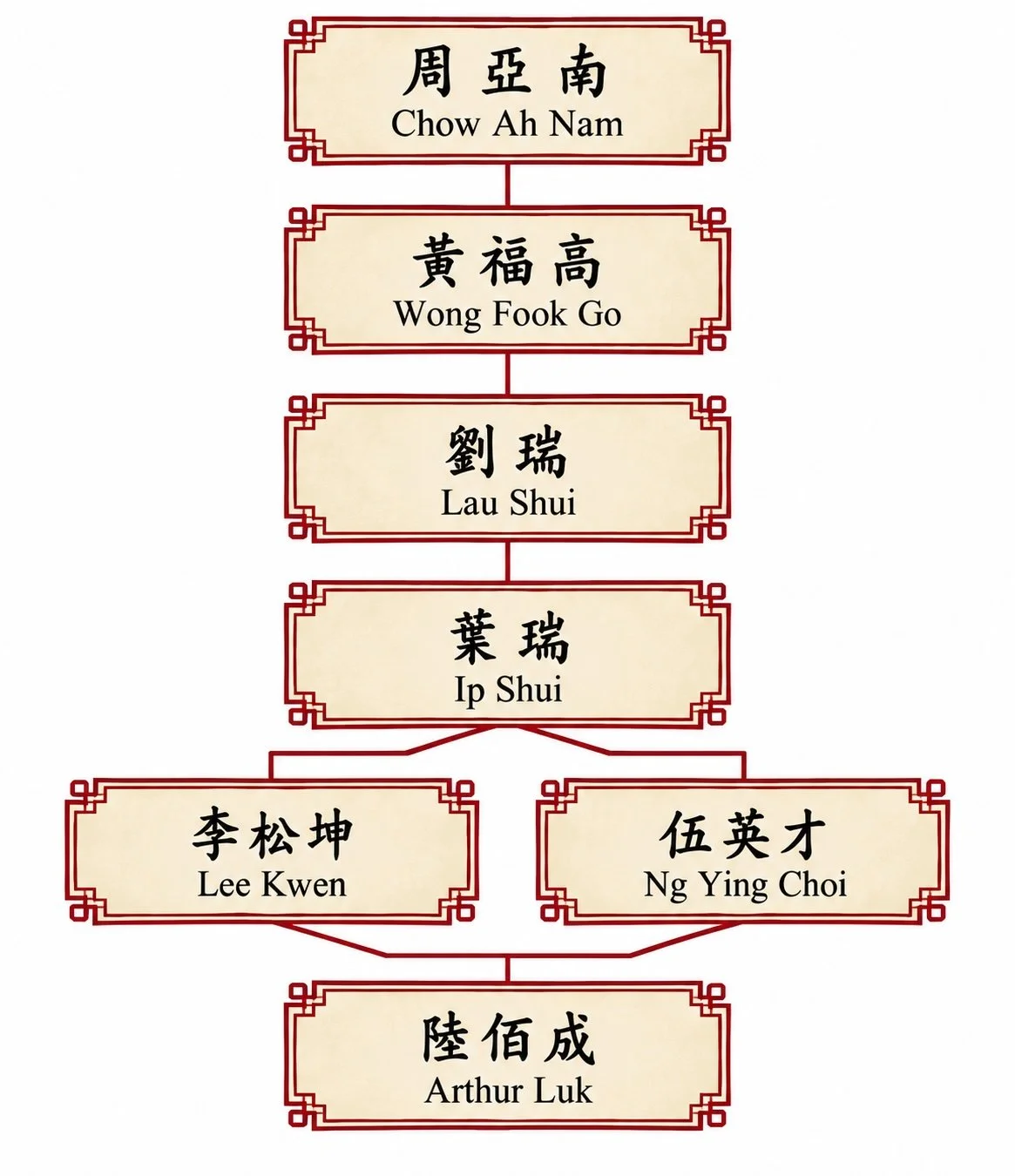
Chow Ga Tǒng Lǒng (Chow Family Praying Mantis) is a rare and prestigious martial art with its origins in the Southern Shaolin Temple, created in the mid-1800s by the founder Chow Ah Nam. The system was carried to the East River (Tung Kong) region of Guangdong by the traveling monk Wong Fook Go, eventually establishing a legendary legacy in Hong Kong through the "Tiger of the East River," Lau Shui, and the subsequent preservation efforts of Grandmaster Ip Shui. The art is renowned for its strong, powerful bridge, Hei Gung training, and its signature Geng Tan Ging (Shock Power). Unlike systems that rely on external momentum, Chow Ga utilizes internal mechanics and explosive short-range force governed by the four directional energies: Fau (Float), Chum (Sink), Tun (Swallow), and Tou (Spit).
Through a heavy emphasis on Hei Gung (Internal Breath Work) and specialized strength training, practitioners develop the essential anatomical pillars of the lineage. These include the Sau Gei Bui (Basket Back), the structural rounding of the upper back to store and release elastic energy; the Dip Gwut Gung (Rib Bone Power), the internal conditioning of the serratus and intercostals to generate force from the torso; and the Dit Chek Yiu (Iron Ruler Waist), a reinforced core that connects the power of the ground to the bridge of the arms. These characteristics, amongst others, allow the practitioner to develop an extremely strong and powerful body that remains nimble and mobile.
Cultivation of Hei (qi) and power are central to the system's practice, which serves as a foundation for both martial power and lifelong vitality. The effectiveness of this conditioning is best demonstrated by the masters of the lineage, who consistently defy conventional expectations of aging. Grandmaster Ip Shui continued to provide powerful public demonstrations well into his 90s. Sifu Ng Ying Choi, even at 88 years old, remains as strong as an ox with an "Iron Body" that is still impenetrable. Throughout the system, teachers in their 70s and 80s continue to display immense strength, speed, and power, serving as living examples of the longevity and resilience that this training provides.
How does CHOW GA TǑng LǑng Shú Work?
周家螳螂塾怎麼運作?
Chow Ga TǒngLǒng Shú operates similarly to an online university, like the University of Phoenix or NYU Online, with a proven effective training method. The program is subscription-based, offering both monthly and yearly billing options. Cohorts are organized into small groups of 10-20 students. Every week, at a designated time, a new pre-recorded lesson is made available for cohorts to stream and watch at their convenience. Each lesson lasts about 35-45 minutes and includes warm-ups, strength-building drills, lectures, forms, and applications.
At the end of each lesson, Sifu assigns training homework to the students. They then have one week to practice, record their homework using their phone or any recording device, and upload the videos to a privately shared Google Drive folder by the designated weekly deadline. Sifu reviews all submitted homework videos, takes notes, and provides personalized feedback through a short 5-10 minute video sent to the cohorts. This cycle repeats weekly.
There are several significant advantages to this training method compared to traditional teaching methods, whether in-person or through typical online training:
Flexible Time: Lessons are pre-recorded, allowing students to stream and watch at their convenience.
Self-Examination: By recording and reviewing their own homework videos, students can self-examine and correct mistakes, which is not achievable through traditional training methods or even by practicing in front of a mirror.
Frame-by-Frame Review: Shifu can review students' training homework frame by frame, a level of detail not possible in person. Some Shifu even take screenshots of the exact moment a mistake is made, providing valuable visual feedback for students.
Rewatch-ability: Unlike in-person teaching, where students may struggle to remember the material after class, streaming video lessons allow students to rewatch as many times as they wish.
周家螳螂塾的運作方式類似於在線大學,例如鳳凰城大學或紐約大學在線,採用經過驗證過的有效訓練方法。該計劃採用訂閱制,提供每月和每年的計費選項。學員被分成10至20人的小組。每週在指定的時間,將有一個新的預錄課程供學員按需串流觀看。每節課持續約35至45分鐘,包括熱身、力量訓練、講解、套路和應用。
每節課結束時,師父會給學生布置訓練作業。學生需要在一週內練習,並使用手機或任何錄影設備錄製作業視頻,然後在指定的每週截止日期前將視頻上傳到私人共享的Google Drive雲端資料夾中。師父會審查所有提交的作業視頻,做筆記,並通過一個5至10分鐘的短視頻為學員提供個性化反饋。這個循環每週重複。
與傳統的教學方法相比,無論是面授還是典型的在線培訓,這種訓練方法有幾個顯著的優勢:
1. 靈活的時間安排:課程是預錄的,忙碌的現代人可以按自己的時間安排觀看。
2. 自我檢查:通過錄製和查看自己的作業視頻,學生可以自我檢查並糾正錯誤,這是傳統訓練方法甚至是在鏡子前練習所無法實現的。
3. 逐幀審查:師父可以逐幀審查學生的訓練作業,這在面對面教學中是無法做到的。有些老師甚至會截取視頻中錯誤發生的精確時刻的截圖,這對學生來說是非常有幫助的。
4. 重複觀看:與實體教學不同,學生在課後經常會難以記住所教的內容。通過串流視頻課程,學生可以無限次地重複觀看。
NORTHERN & SOUTHERN MANTIS DISTINCTIONS
北方與南方螳螂拳的區別
Originally, there were no such distinctions, and styles were not named with "Southern" or "Northern" prefixes. In its earliest days, our system was known simply as Praying Mantis. The geographical labels were adopted later to differentiate the arts of the Pearl River Delta and Hakka regions from those practiced in North China. Just like the North, the systems in the South are also varied, comprising many different branches and lineages.
While Northern systems often utilize long-range agility and expansive movements, Southern Praying Mantis is a compact "In-Fighting" art. We prioritize rooted stability and the ability to destabilize an opponent at close quarters using rapid-fire bridge hand tactics without the need for large wind-ups to generate power. This efficiency allows the practitioner to overwhelm an opponent’s structure through superior internal mechanics and explosive pressure, resulting in movements that are often perceived as very short (0–3 inches) without excessive wide actions.Though all Southern Mantis systems share the same core elements and hand shapes, Chow Ga Tong Long differentiates itself with a heavy emphasis on partnered training and specialized strength development.。
Sifu Arthur Luk
陸佰成 師父簡介
Sifu Arthur Luk began his formal practice at age 14 in New York City's Chinatown, training within the first and oldest Chow Ga Mantis group in the United States. This family legacy has been intertwined with the system's American roots for decades; his father and uncle practiced under Sifu Ngai Pui Tan—the founder of the NYC group and a first-generation student of Ip Shui—during the 1950s. Arthur's father was instrumental in helping Sifu Lee Kwun (who started in 1948) immigrate from Hong Kong to NYC, where Lee eventually took over as the head instructor of this historic group. Arthur trained under Sifu Lee Kwun from 2002 to 2017, internalizing a method that prioritized fluidity and power. Lee emphasized that training should never feel forced, focusing instead on natural movement to allow for the effortless cultivation and expression of skill—a foundation to which Arthur attributes his technical prowess. Even during his time in Hong Kong, Arthur continued to learn and refine his skills under Lee up until his passing in 2023.
From the early 2000s to the present day, Arthur has consistently cross-trained in other disciplines to better understand how Southern Mantis applies to the outside world. This journey has included Shaolin Kungfu, Muay Thai, Filipino Kali, Shuai Jiao, and BJJ, alongside a dedication to rock climbing and weightlifting. In 2013, seeking to share these insights and aid in the style's exposure in the West, he created the Evosbasics channel. By producing simple technique tutorials for beginners, he was able to connect with a global audience and document his own journey of refinement.
In 2011, Arthur met Sifu Ng Ying Choi (who started in 1973), a practitioner renowned for his immovable bridge, shock power, and Iron Body skills. Arthur eventually moved to Hong Kong in 2017 to train full-time at Sifu Ng's school until 2025. Ng utilized a very hands-on approach, ensuring students felt the techniques and structural differences within their own bodies. He was meticulous and extremely detailed; his teaching embodied the philosophy that "perfect practice makes perfect," where even a single inch of misalignment was corrected. It was during this deep dive that the mechanics of the system became clear, and Hei Gung moved beyond the mystical to become something tangible that Arthur could feel and replicate. During this immersion, he also helped implement specialized Hei Gung practices and witnessed students recovering from serious injuries to the spine, knees, and even respiratory issues.
This synthesis of tradition and modern movement science defines Arthur's approach to Chow Ga TǒngLǒng, which he treats as a sophisticated form of functional strength training for martial artists. His teaching focuses on building a structure capable of both neutralizing pressure and expressing it explosively through specific exercises and Hei Gung for every section of the body, from the head down to the toes. By focusing on core fundamental principles rather than style/sport specifics, Arthur aims for an approach that helps as many people as possible achieve longevity, resilience, and high-performance movement.。
Condensed program
濃縮訓練
Traditionally, Chow Ga TǒngLǒng training would take at a decade or longer to developed decent Chow Ga TǒngLǒng skills. In the modern days, the martial scene is no longer the same as the old days. It is rare and difficult for general martial arts enthusiasts (non-professionals) to dedicate 10+ years of time to follow the traditional training procedures under a master... We carefully examine the traditional curriculums and training methods, combined with modern training mindset. We designed an optimized curriculum that only teaches the “real stuff”(in which are usually the hard and not so fun stuff) within a condensed training timeline. With the goal to pass down the correct knowledge of authentic traditional Chow Ga TǒngLǒng,
傳統上,周家南螳螂的訓練需要十年甚至更長時間才能培養出像樣的螳螂拳技能。然而,在現代,武術界已經與過去大不相同。對於一般的武術愛好者(非專業人士)來說,很難再像過去那樣,花費十年以上的時間在師父的指導下遵循傳統的訓練程序。我們仔細研究了傳統教材和訓練方法,結合現代的訓練理念,設計出一套優化的課程,僅教授“真材實料”(通常是艱難且不那麼有趣的內容),並在縮短的訓練時間內完成。目標是傳承正宗傳統南螳螂的正確知識。
Who is TángLáng Qúan Shu for?
什麼人適合加入周家南螳螂塾?
Basically anyone who has a passion in TCMA, for all ages and gender. Chow Ga TǒngLǒng’s biomechanics is complementary to other styles and even sports and dance arts. However, Chow Ga TǒngLǒng training is intensive on the lower body strength development, especially on the knees. If you have previous knee injuries, please notify Tsáng Wǔ Gé admin before begin lessons.
基本上,任何對中國傳統武術(TCMA)有熱情的人,無論年齡和性別,都可以參與。螳螂拳的運動力學可以與其他武術流派、甚至是運動和舞蹈藝術相輔相成。然而,螳螂拳訓練對下肢力量的發展要求很高,特別是對膝蓋。如果您有過膝蓋受傷的經歷,請在開始課程前通知藏武閣的管理人員。
Is TángLáng Qúan practical?
周家南螳螂拳能實戰嗎?
It depends on the lineage of the TǒngLǒng Kǔen being studied. Some TǒngLǒng Kǔen focuses on performance and competition. The Chow Ga TǒngLǒng Shú passed down from Tung Gong, Guangdong, however, prioritize rooted stability and the ability to destabilize an opponent at close quarters using rapid-fire bridge hand tactics without the need for large wind-ups to generate power. This efficiency allows the practitioner to overwhelm an opponent’s structure through superior internal mechanics and explosive pressure, resulting in movements that are often perceived as very short (0–3 inches) without excessive wide actions.. This emphasis on practicality has led it to be known as the combat kungfu.
What to expect at the end of the program?
第一階段上完預期成果
By the end of the two‑year program, students can expect to develop a fundamental grasp of Chow Gar stance work, core hand techniques, essential Hei Gung practices, and the strength, power‑generation, joint conditioning, and body connection methods needed to continue progressing in Chow Gar Southern Praying Mantis.
完成兩年課程後,學員將對周家的樁法、核心手法、基礎氣功練習,以及在周家南派螳螂拳持續進步所需的力量訓練、勁力發放、關節鍛鍊與全身連貫方法,建立起紮實的基本功。
What is Tsáng Wǔ Gé?
藏武閣是什麼?
ADo you love traditional martial arts? Do you feel they are slowly fading into history?
Traditional martial arts are in decline, and rival schools often look down on and undermine each other. So even though many people love martial arts, the martial arts community, the wulin 武林, cannot unite. Its strength is scattered, and teachers and coaches are left to teach quietly on their own. As a traditional martial artist, I feel a strong sense of mission. Drawing on my years of running a marketing company, I am copying the successful model of Baji Shu to other excellent styles. By partnering with leading traditional masters and using the technology of our generation, we can build a sustainable framework for passing down traditional martial arts.
That is how Tsang Wu Ge 藏武閣 was born!
Tsang Wu Ge is modeled on the Central Guoshu Institute of the past: it brings together masters from many schools under one roof, with one shared purpose. Our goal is to rebuild a sustainable wulin. It will be free of insults between schools and of masters holding back their knowledge, and no one will spend ten years just to learn a single technique. It will be organized, run with professional branding, and in step with the times!
Tsang Wu Ge starts online. Our basic goal is to establish correct training methods and a sound understanding of traditional martial arts. We aim to develop more talent and to grow the market for traditional martial arts. We will not overlap or compete with traditional ways of teaching. Instead, the two will support each other.
After founding Baji Shu in 2022, we partnered with Master Han Ji-Xiang of Han Men Wu Ji in 2024 to launch Changquan Shu. It lets people around the world study authentic Changquan (Long Fist) in a structured way. This is not the exaggerated Long Fist of performance wushu, nor the Long Fist treated only as a beginner's training set. It is a deep, traditional martial art with real combat value. Since then, we have worked with leading traditional masters to launch Hung Ga Shu, Bagua Shu, QiXing Mantis Shu, Chow Ga Mantis Shu and Xī Yì Shú, each a complete system of a traditional Chinese martial art. Tsang Wu Ge will also offer related electives, such as Ben Cao Tang (Chinese Herbal Medicine), Zhen Jiu Tang (Acupuncture) and Wu Yu Tang (Martial Language). These electives complement the training in each Shu and support Tsang Wu Ge's ultimate goal: preserving traditional martial arts and promoting the culture behind them!
I believe Tsang Wu Ge will be a turning point that changes the martial arts world. Our team needs startup funding to cover early preparation and six months of operating costs. If you, our seniors in the martial arts community and fellow practitioners, share Tsang Wu Ge's vision, please give generously. Every contribution counts, and every little bit adds up! We also welcome your ideas and introductions to people who could help. Thank you all for your support!
The website linked below has a video with the full project details and information on how to donate:
www.tsangwuge.com/take-action
你喜歡傳統武術嗎?你覺得傳統武術正在慢慢的走入歷史嗎?
由於傳統武術的勢微及門派間的互相鄙視和扯後腿現象,即便熱愛武術的人雖多,但「武林」卻無法團結,導致力量分散,各家老師教練們只能各自默默教學傳授。身為傳武人的我,感受到一股使命感,利用我多年經營行銷公司的經驗,將八極塾的成功運作模式複製到其他優良拳種;與頂尖的傳武老師合作,利用我們這個世代的科技優勢來為傳武的傳承設立一個永續框架。
「藏武閣」因此而誕生!
藏武閣以當年「中央國術館」的概念為基礎,萬眾一心,將各家高手齊聚一堂。藏武閣的目標是重新創建一個能永續發展的「武林」,一個沒有相互謾罵、師父拿藝、十年練一劍的「武林」,一個有組織性、有品牌經營手法、一個能跟時代接軌的「武林」!
藏武閣從網路開始,以建立正確傳武訓練的方法及觀念認知為基本目標。「藏武閣」的推廣方式志在儲備更多傳武的人才資源,拓展傳武的市場潛力,並不會與傳統的傳授模式產生重疊或衝突,只會相互助益。
我們從2022年最先成立的「八極塾」之後於2024年與「韓門武集」的韓基祥老師合作推出「長拳塾」,讓全世界能有系統地學習正統的「長拳」。這不是武術表演中動作誇張的長拳,也不是只能當作初級練習套路的長拳;而是有深度、有技擊價值的優良傳統武術。繼「長拳塾」推出之後,我們陸續與各家頂尖傳武老師合作,推出「洪家塾」、「八卦塾」、「七星螳螂塾」、「周家南螳螂塾」、「心意塾」等優良傳統國術拳種體系。除此之外,藏武閣也會提供許多相關選修課程,如:「本草堂」、「針灸堂」、「武語堂」等。這些選修課將與各「塾」的研習相輔相成,進而達到「藏武閣」傳承傳統武術及推廣文化的終極目標!
我相信「藏武閣」將會是改變武林生態的轉淚點。我們的團隊需要一筆啟動資金來支持前期準備到六個月的運作資金。如果各位武林前輩和同好武友認同「藏武閣」的理念,請慷慨解囊。無論多少,只望積少成多!我們也歡迎各種意見和人脈介紹,感謝大家的支持!
以下的連結網站有更詳細的企劃說明影片與捐款方式:
www.tsangwuge.com/take-action
For any questions, email TsandWuGe administrator at: admin_vmei@tsangwuge.com